
Historic Murphysburg
In recognition of Indigenous Peoples’ Day….the life of Jere Charlow

101 South Sergeant Avenue Circa 1908 Features: bay windows and gabled Dormer
At a Glance
- Address
- 101 South Sergeant Avenue
- Year Built
- 1908
- Current Use
- Single family dwelling
- Public Access
- Private residence
- Preservation Status
- Standing
- District / Designation
- Murphysburg Residential District
Please enjoy this place from public rights-of-way and respect current residents.
Story
In recognition of Indigenous Peoples’ Day, we present an overview of the life of Jere Charlow, the original owner of a house in the Murphysburg Historic District at 101 South Sergeant Avenue. The house is an American Foursquare with bay windows & gabled dormers built around 1908.
While living in Joplin with wife Maude Ellen Gregg Charlow (1876-?), Jere J. Charlow (1880-
1947) was a bookkeeper for Picher Lead Company and a member of the Joplin Elks Club.
When he left Joplin, he become a clerk with the United States Indian Service-Cheyenne
Agency in Dewey, South Dakota. Upon his death, he was a special disbursement agent for
the United States Government Interior Department in Lansing, Michigan. Jere is buried at
Saint Joseph Catholic Cemetery in Lansing, Michigan. Jere maintained his membership in
the B.P.O. Elks Lodge No. 501 of Joplin and was honored at the Elks annual memorial
service after his death.
The Indian Leader newspaper in Lawrence, Kansas, printed an article about Jere on March 10, 1905 stating, “He
has made himself indispensable to his employers, receives a handsome salary and is
trusted and greatly respected by all who know him.”
The 1910 U.S. Census listed Mr. Charlow as “Indian” (Native American) born in Wyandotte, Oklahoma in 1880, however the birthplace of his parents was unknown. One news article reported that Jere was a member of the Sioux Tribe. According to the 1910-1911 Wyandot2 census, Jere’s Indian blood was denoted as ¼ degree and his allotment number was 218. He was an 1898 graduate of the Haskell Institute, located in Lawrence, Kansas. The school’s current name is Haskell Indian Nations University. The school was founded in 1884 as a residential boarding school for American Indian children.

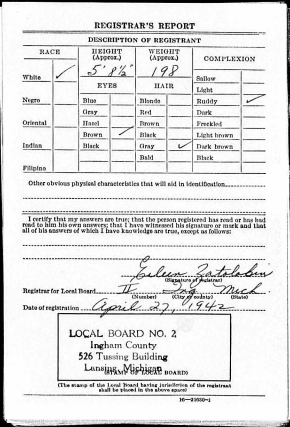
Then again on April 27, 1942---at 61 years old---Jere was obligated to register in the “Fourth Registration” of the World War II draft. Also known as the “Old Man’s Draft,” it was intended to provide the government with a register of manpower between 45-64 years of age who might be eligible for national service on the home front. Interestingly, his “Registration Card” listed his race as White.


On September 12, 1918---at 38 years old---Mr. Charlow was registered for U. S. military service and was listed as an “Indian.” His occupation was denoted as a clerk for the United States Indian Service-Cheyenne Agency in Dewey County, South Dakota.
Mr. and Mrs. Charlow had one son, named Joseph Jere Charlow.
While this short biography gives readers an introduction to Jere Charlow, in no way does the story paint the entire picture of his life and the situation in Oklahoma, Kansas, and Missouri regarding Indigenous Americans, The Dawes Act regarding land allotments, boarding schools, tribal affiliations, etc.
INDIGENOUS PEOPLES' DAY According to the Smithsonian-National Museum, American Indians represent less than one percent of the U.S. population, yet names and images of Indians are everywhere: military weapons such as the Tomahawk missile, baking powder cans, town names, advertising, professional sports (Go Chiefs!) and that holiday in November. Furthermore, the Smithsonian said, “Americans have always been fascinated, conflicted, and profoundly shaped by their relationship to American Indians.”
People in the Joplin Tri-State Area are also familiar with the casinos operated by various Indian Nations.
On October 8, 2021, President Joe Biden issued Proclamation 10283, recognizing October 11, 2021, as Indigenous Peoples’ Day and calling for its observance. That date was the second Monday in October, also observed as Columbus Day. Each state has its own observation criteria (or lack thereof) for both holidays. Missouri does not recognize IPD as a public holiday, but Columbus Day will be recognized as a state holiday on October 14, 2024.
Architecture
The two-story pyramidal house has a limestone foundation and wide eaves. A one-story bay window projects from the north elevation. A gabled dormer rises from the east slope of the roof.